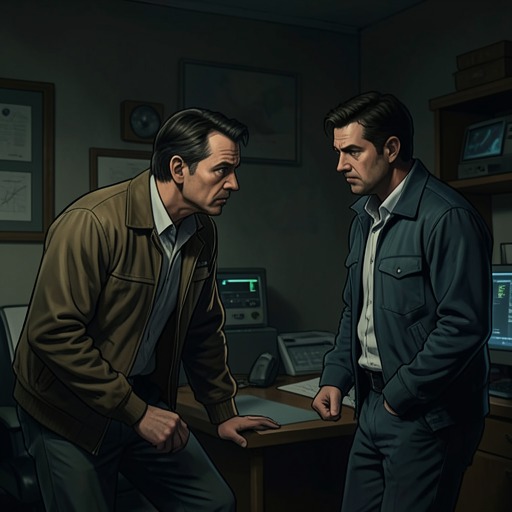
Alec Leamas and Control
The Spy Who Came in from the ColdAlec Leamas and Control are operative and chief, but their relationship is more than a chain of command: Control recognizes Leamas’s exhaustion and grief, offers him a way out of espionage, and speaks as though sympathy can survive their profession. At the same time, he directs Leamas into a dangerous operation, withholds its full terms, and makes Leamas’s apparent exposure part of the plan. Their bond is therefore defined by a tension between personal solicitude and institutional use: Control offers a return from the cold, but only after asking Leamas to go farther into it.
Command and First Signs of Concern
Control’s authority is established in their early meeting through small, careful gestures. He shakes Leamas’s hand as if assessing him, invites him to sit by an olive-green electric fire, and asks whether he is tired or burnt out. The tentative manner softens the hierarchy without removing it: Control has called the meeting, knows what he wants to discuss, and can determine whether Leamas is fit for further work.
When Leamas says the decision is up to him, Control reflects on the emotional cost of their profession. He argues that people in their world cannot remain without sympathy indefinitely, even if they act hard toward one another, and describes the need to come in from the cold. The phrase offers a language for release from espionage, but the scene also connects it to remembered wartime suffering: Leamas sees refugees on a road and an air attack. Their discussion does not make their work gentler; it shows that both men understand how its demands are entangled with human vulnerability.
The Operation and Its Moral Rationale
Control proposes getting rid of Mundt even though Leamas points out that the British have nothing left in East Germany to protect: Riemeck was their last asset there. Control’s rationale is not the preservation of a remaining network but a comparison of methods. He says that, since the war, the methods of the British and their opponents have grown much the same, and argues that a government’s benevolent policy cannot excuse being less ruthless than its adversary. The proposal places their personal history inside the institution’s defensive ethic: the operation is presented as necessary because the other side is ruthless, even as that claim makes the distinction between the sides harder to sustain.
Control does not initially disclose the operation’s full shape. He invites Leamas to spend time with the newer staff, including Guillam, and then to stay with him for a weekend, where they can discuss matters in comfort. He says Leamas may keep whatever money he makes. The unusually generous terms sit alongside Control’s mild, almost apologetic manner, but money and hospitality are also practical inducements to return to work. When Control asks whether Leamas is sure he wants to continue, Leamas answers that he is willing if the task is killing Mundt. Control tests the answer, then interprets Leamas’s response as evidence of numbness rather than straightforward hatred: in their line of work, he says, people can be left with nausea and a wish not to cause further suffering. He links that reaction to the shooting of Riemeck and Leamas’s subsequent walk through Berlin, while Leamas confirms only that he went walking.
Concern for Leamas and Liz Gold
Control’s concern becomes personal when he asks about Liz Gold, whom he knows to be in the Party. Leamas immediately says he does not want her brought into the operation. Control responds sharply, asking who suggested that she should be involved. The exchange shows that Leamas’s attachment has created a boundary he wants to keep between his private life and his work; Control’s answer briefly breaks through his academic detachment, though it does not dispel the uncertainty surrounding what the operation may require.
Later, Control calls the assignment Leamas’s last job and promises that he can then come in from the cold. He asks whether Leamas wants money or anything else done for Liz, and Leamas says he will take care of it himself when the operation is over. Control agrees that action now would be insecure. His offer acknowledges a future beyond service and the practical needs of someone Leamas cares about, but it also makes that future conditional on the mission’s completion. Care is present, yet it operates within the same security logic that keeps the two men from acting openly.
Control’s Hidden Terms and Leamas’s Eastward Journey
Control’s assurances acquire a darker meaning after Leamas is told that he is wanted under the Official Secrets Act and has appeared in London evening papers. Leamas concludes that Control started the public pursuit. He recalls the earlier explanation: the interrogation might take a couple of weeks, after which he would lie low while the operation developed, supported on operational subsistence until Mundt was eliminated. In retrospect, the generous financial arrangement no longer looks like simple compensation. Leamas reads it as a warning that Control expected the dangers to be greater than he had admitted, and as an inducement designed to keep him committed if the plan became difficult to leave.
At this point Leamas recognizes that refusing to go east with Peters might wreck the operation, but he cannot know whether Peters is telling the truth or testing him. Because he is notionally wanted in the West, he sees that agreeing to go could leave him with no credible route back. His decision to continue is therefore made under conditions Control has helped create: the mission’s apparent momentum, the risk of being exposed, and the uncertainty about what has been withheld all narrow his choices.
The crossing into the East makes that dependence visible in action. Leamas travels with Peters in a Mercedes, while a DKW passes ahead and clears the West German checkpoint. The barrier rises, and both vehicles cross the stretch between checkpoints together. Leamas notices the Eastern fortifications—concrete obstacles, observation towers, and barbed wire—before the Mercedes passes through the next checkpoint without stopping. What had been described as a final assignment and a route back to ordinary life has become a journey deeper into the opposing system. Control’s promise of release remains the relationship’s defining hope, but the terms of the operation leave Leamas moving east without assurance that he can return.